Category: Uncategorized

  • The Future of FMCG Strategy: Why Integrated Intelligence Wins 

    The Future of FMCG Strategy: Why Integrated Intelligence Wins 

    Every FMCG executive today faces the same paradox. The company has more data than ever before. There are dashboards, social listening reports, category trackers, and retailer scans. Yet decisions often feel slower and less confident. 

    Despite sophisticated analytics and agency reports, many leadership teams still discover market shifts only after competitors have already acted. The challenge is no longer access to data. It is the ability to connect it fast enough to matter. 

    The New Reality: Data is Everywhere, But Foresight is Rare 

    In the past, it was enough to review quarterly brand reports or rely on annual research to guide planning. That rhythm no longer fits the pace of today’s market. Consumer behavior changes weekly. 

    A local influencer can alter purchase intent overnight. A shift in retail visibility can cause brand equity to drop in days. A regional competitor can launch a new flavor or variant and instantly test demand through online channels. 

    Across Asia, FMCG leaders are struggling with this acceleration. Marketing knows campaign reach, sales know distributor performance, but product and innovation teams often do not see those signals until months later. The result is fragmentation. Decisions become reactive instead of strategic. 

    Integrated Intelligence bridges that gap. It connects the dots between brand health, consumer sentiment, competitive movement, and in-market performance in real time. It enables leaders to sense market shifts early enough to act on them. 
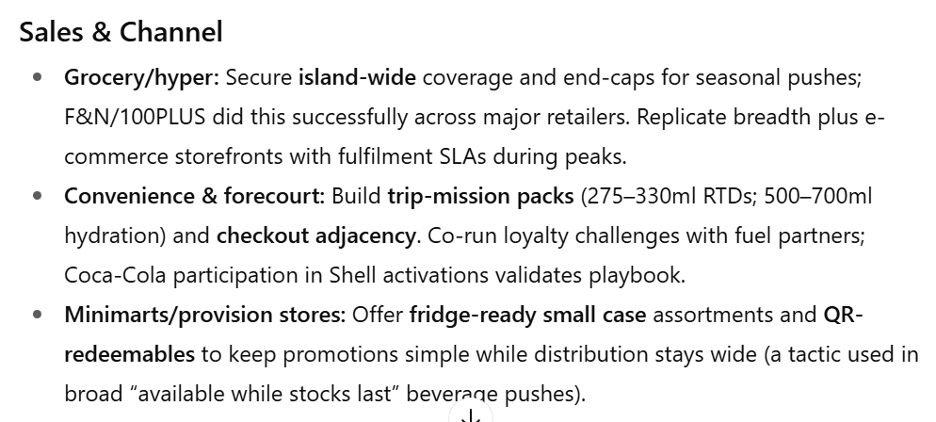
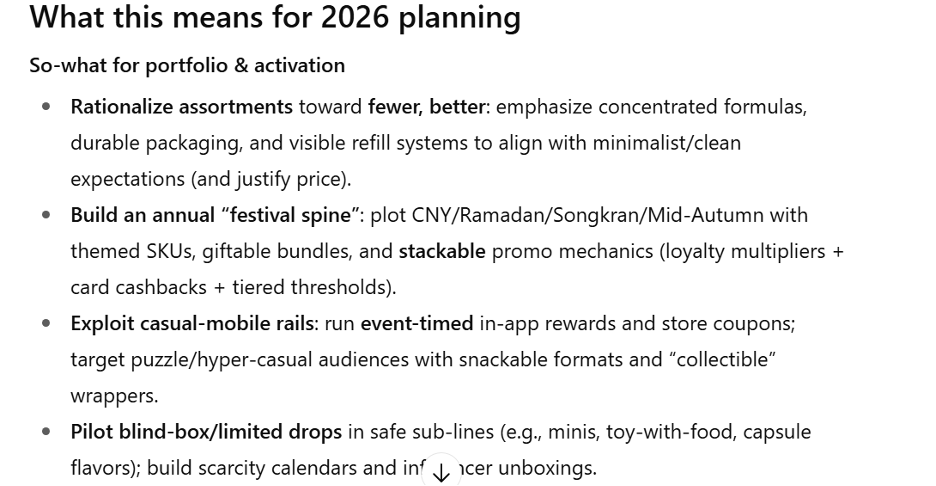
    (Pulse screenshot showing how the Sales / Channel team can take advantage of the trends happening in the beverage space)

    Why the Traditional Intelligence Model No Longer Works

    Traditional business intelligence platforms were built for stability, not speed. They report what happened last month or last quarter, but not what is happening right now.

    In categories where shelf space and consumer attention shift daily, disconnected data means lost opportunity.

    To stay ahead, FMCG leaders must evolve from static reporting to dynamic intelligence. They need systems that merge real-time market sensing with decision automation and human judgment.

    The Rise of Integrated Intelligence

    Integrated Intelligence means that every signal, from campaign performance to consumer reviews to retail scans, contributes to a single living picture of brand health. It combines the agility of marketing analytics with the rigor of commercial data, enabling leadership teams to operate as one unified organization rather than a collection of separate departments.

    Imagine your team knowing that a competitor’s new beverage variant is trending on social media, detecting a spike in conversation among Gen Z audiences, and linking it immediately to your own declining search share in the same category. With Integrated Intelligence, that connection happens automatically. Teams can respond within hours instead of weeks.

    This is not about having more reports or more numbers. It is about having a unified intelligence layer that connects decisions across marketing, sales, and innovation.

    What It Changes for FMCG Leaders

    For marketing, Integrated Intelligence means being able to see how brand perception, paid campaigns, and influencer content interact in real time. When sentiment dips, leaders understand why and can respond before the next planning cycle.

    For sales and trade, it means linking promotions, retailer data, and market share instantly. Leaders can see how an in-store activation or price change influences brand equity within days instead of waiting for post-campaign reviews.

    For product and innovation, it provides visibility into emerging demand patterns. Leaders can see which claims or flavors are gaining momentum across platforms and use that insight to guide product development and launch timing.
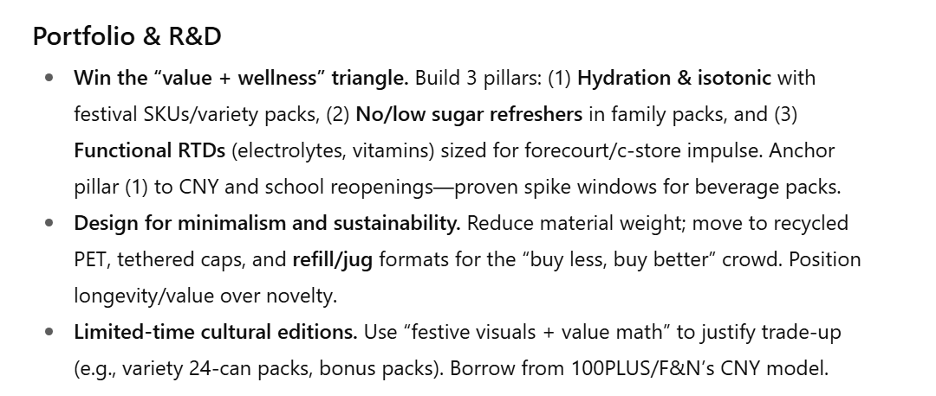
    (Pulse screenshot on how the Portfolio & R&D department of a beverage company can plan ahead by taking note of the trends in the space)

    For executives, it provides foresight. It shifts the leadership mindset from reacting to last quarter’s performance to shaping the next one proactively.

    The Leadership Imperative

    Adopting Integrated Intelligence is not just a technology project. It is a leadership challenge.

    FMCG leaders must rethink how teams share information and define success. Marketing cannot optimize purely for impressions while sales focus only on volume. The true advantage lies in connecting both perspectives.

    Executives who lead this change are already seeing a measurable impact. They are reallocating budgets dynamically, identifying competitive threats early, and aligning marketing and sales execution behind a single shared narrative. As one Asia-Pacific CMO recently said, “Our speed to insight has become our edge. We now plan in days, not quarters.”

    Integrated Intelligence transforms speed into strategy.

    Pulse: Powering the Next Era of FMCG Intelligence

    This is the vision behind Pulse, GrowthDesk’s FMCG intelligence engine. Pulse brings together live data across marketing, sales, product, and competitive activity. It provides a single source of truth for brand health, consumer trends, and market movements.

    With Pulse, organizations no longer rely on disconnected dashboards or delayed reports. They operate with a shared rhythm of insight, keeping marketing aligned with sales and strategy aligned with the market.

    The Competitive Edge of the Next Decade

    The next decade in FMCG will belong to brands that master speed, foresight, and integration. Inflationary pressures, rising media costs, and the growth of social commerce will continue to reshape the consumer’s journey.

    In this environment, intelligence cannot sit in isolation. It must flow freely across the enterprise. Integrated Intelligence is the framework that makes this possible, and Pulse is the engine that powers it.

    The future of FMCG will not be won by the brands that have the most data. It will be won by the brands that can connect the data points.

  • How FMCG Brands Can Spot Tomorrow’s Trends Before They Go Viral 

    How FMCG Brands Can Spot Tomorrow’s Trends Before They Go Viral 

    In the fast-moving world of FMCG, reacting to consumer demand is no longer enough. By the time a trend becomes visible in sales data or store shelves, it is often already dominated by early movers. The next era of brand growth belongs to those who can predict what consumers will want before they know it themselves. 

    That is the promise of anticipatory intelligence, and it is what Pulse, GrowthDesk’s FMCG intelligence engine, was built to deliver. 

    The Age of Anticipation 

    The traditional model of consumer insight runs on delays. Surveys, quarterly scans, and campaign retrospectives capture what consumers did, not what they are about to do. 

    But today’s consumers do not move in quarters. They move in moments shaped by what they see on TikTok, read in group chats, or discover in local stores. A viral drink trend can take off in days, while a new wellness movement can reshape entire categories within months. 

    This pace means that being real-time is no longer fast enough. FMCG brands must shift from reaction to anticipation, and that begins with decoding the earliest signals of change. 

    Decoding Weak Signals Before They Amplify 

    Every major market shift begins as a faint signal in the data. Before a new behavior becomes mainstream, it appears as small, inconsistent patterns. It might be a slight rise in niche ingredient searches, a handful of micro-influencers talking about a lifestyle shift, or a spike in trial purchases within certain demographics or regions. 

    Individually, these fragments seem random. But when connected and analyzed over time, they form the early DNA of a future market. 

    Pulse’s intelligence framework is designed precisely for this. It detects, connects, and contextualizes weak signals across multiple data sources including retail transactions, social buzz, competitor activations, and promotional activity. 

    This integrated view allows Pulse to surface early insights that would otherwise remain invisible until much later. It enables brands to identify tomorrow’s demand today and act before competitors have even noticed the change. 

    From Data to Foresight: The Pulse Advantage 

    What sets Pulse apart is not just the scale of data it processes but how it transforms that data into foresight. 

    Real-time Category Mapping 

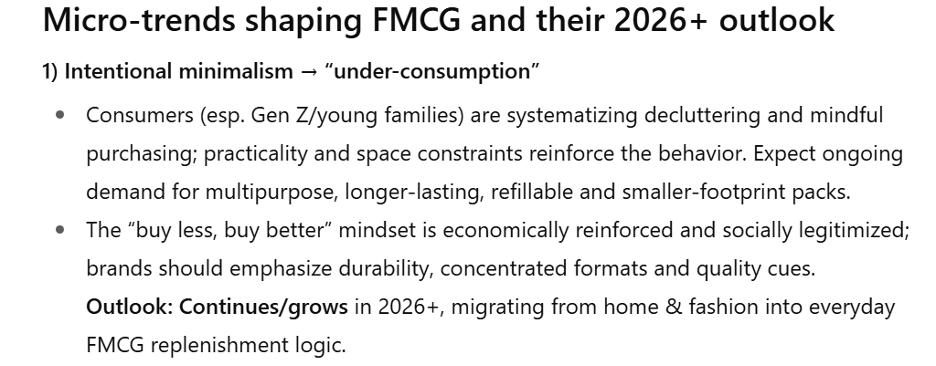
    Pulse identifies emerging micro-trends within FMCG categories by tracking the velocity and sentiment around evolving consumer needs such as affordable indulgence, protein-on-the-go, or eco-conscious cleaning.

    (Pulse Screenshot analyzing micro-trends in the FMCG Space)  

    Competitive Activity Layering

    It monitors competitive signals such as product launches, pricing shifts, and campaign bursts, revealing how other brands are positioning themselves around early consumer interests. 

    Predictive Pattern Recognition

    By combining data from SKALE’s shopper intelligence and GrowthDesk Studios’ campaign performance, Pulse finds repeatable patterns that historically precede category growth, such as keyword surges, sentiment shifts, or correlated product trials. 

    Actionable Dashboards and GenAI Insights

    Instead of static reports, Pulse provides adaptive dashboards and conversational interfaces that allow marketers, product managers, and executives to explore “what’s next” through natural language queries or scenario simulations. 

    Together, these capabilities turn fragmented data into a living map of consumer evolution. They give every brand function, from R&D to senior leadership, a shared view of where the market is heading. 

    Why This Matters to Different Teams in your Organization 

    One of Pulse’s greatest strengths lies in its versatility across business functions. 

    For Marketing Teams: Pulse enables planning around emerging motivations rather than past performance. Campaigns can be crafted to resonate with what consumers are about to care about, not just what they cared about yesterday. 

    For Sales Teams: Pulse highlights early category momentum by region or retailer, allowing sharper trade pitches, smarter promotions, and more efficient shelf allocation. 

    For Product and Innovation Teams: Pulse guides innovation pipelines by identifying unmet needs before they become saturated markets. It helps teams test concepts aligned with early demand signals rather than relying solely on backward-looking data. 

    (Pulse screenshot showing how to use and take advantage of the micro-trends happening the FMCG space) 

    For Executives: Pulse delivers a foresight advantage. Leaders can make strategic decisions and investments with confidence, backed by data that signals future growth areas rather than merely reporting past results. 

    In essence, Pulse does not just monitor the market. It helps shape it. 

    The New Playbook for FMCG Foresight 

    The FMCG industry is undergoing a fundamental shift from insight to foresight. The brands that thrive in the coming years will share one defining capability: predictive empathy. 

    Predictive empathy is the ability to sense the emotional, social, and practical motivations behind emerging consumer behaviors and to design products, messages, and experiences that meet them before competitors do. 

    This requires more than data collection. It requires interpretation. Brands need intelligence systems that not only capture what is happening but also explain why it matters. Pulse provides this interpretive layer, transforming data streams into an early warning system for opportunity. 

    By combining real-time market tracking, competitive intelligence, and predictive analytics, Pulse allows FMCG organizations to operate with the clarity and agility once reserved for digital-native brands. It converts uncertainty into strategy and insight into impact. 

    Final Thought 

    Every consumer trend starts small. The real advantage lies in recognizing it early enough to act. 

    With Pulse, you can finally bridge the gap between observation and anticipation. They can see not just what is happening, but what is about to happen. 

    In today’s competitive world, the brands that grow are not the ones chasing the market. They are the ones creating it. 

  • The Hidden Science of FMCG Promotions: Where Psychology Meets Data 

    The Hidden Science of FMCG Promotions: Where Psychology Meets Data 

    Promotions have always been at the heart of FMCG marketing. From supermarket shelves lined with “Buy One Get One Free” offers to limited-edition packaging and influencer-driven giveaways, every promotion aims to capture attention and influence choice. 

    But behind every offer lies a complex mix of psychology, timing, and data. Promotions are no longer just an art of persuasion; they have become a science of prediction. In a world where consumer behavior shifts daily, understanding the data behind each purchase has become essential for marketers, sales leaders, and product innovators alike. 

    Understanding the Psychology Behind Every Purchase 

    Every promotion taps into deep-rooted human instincts. Scarcity creates urgency. Reciprocity builds loyalty. Social proof encourages trust and imitation. These behavioral principles are the foundations of why promotions work. 

    In the FMCG world, where decisions are often quick and habitual, these cues shape much of what ends up in a shopper’s basket. Yet not all promotions succeed equally. A “Buy One Get One” offer that boosts sales in Singapore may underperform in Malaysia. A viral contest on social media could outperform a traditional price cut. 

    The difference often lies in timing, context, and the surrounding competitive landscape. This is where data reveals what psychology alone cannot — the why and how behind each behavioral shift. 

    From Intuition to Data-Driven Precision 

    For years, FMCG teams have relied on post-campaign reports and gut instinct to guide their next move. But today’s world generates a constant stream of data from stores, retailers, and consumers. Every campaign leaves behind a digital footprint. 

    Intelligence platforms such as Pulse by GrowthDesk bring this data together into one view. They track what brands and retailers are promoting, how consumers are responding, and which messages are gaining momentum across social channels. 

    This level of visibility replaces intuition with precision. Instead of asking “What worked?”, marketers can now ask “What will work next?” By analyzing billions of data points from promotions, retailer programs, and consumer sentiment, brands can uncover patterns that drive measurable results. 

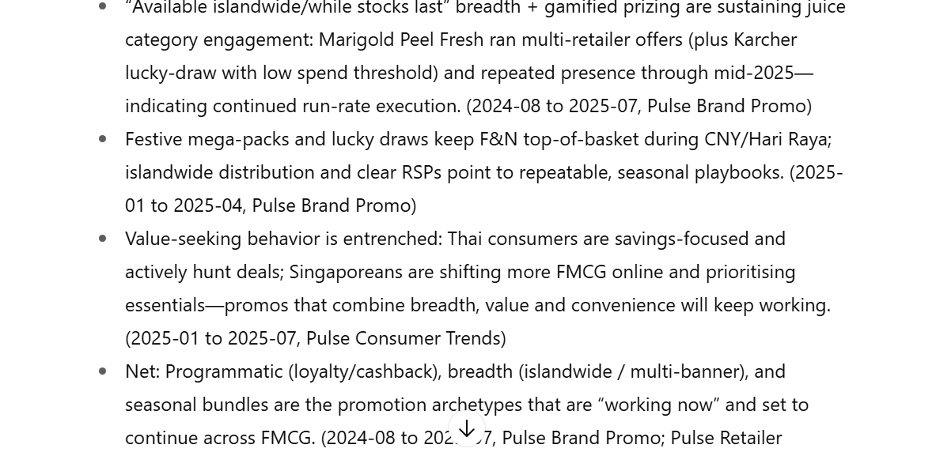
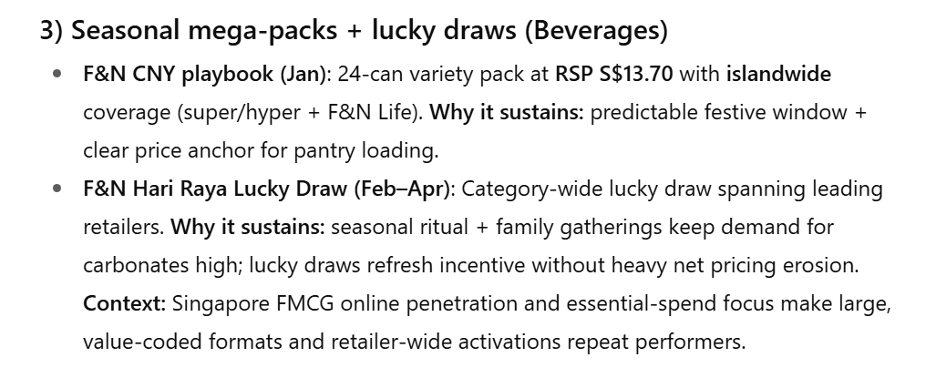
    (Pulse Screenshot showing FMCG effective promotions in the region) 

    For instance, data may reveal that bundled offers perform best during festive months, while in-store contests drive higher engagement during new product launches. These insights turn promotions from experiments into repeatable success formulas. 

    Data as a Unifying Language Across Teams 

    The value of promotional intelligence goes beyond marketing. 

    Sales teams use it to align proposals with retailer calendars, ensuring their activations complement rather than compete with store campaigns. 

    Product and R&D teams monitor consumer sentiment to uncover unmet needs and innovation gaps, identifying emerging themes such as “better-for-you” snacks or eco-friendly packaging. 

    Executives and strategists use data to track brand health, benchmark against competitors, and spot category shifts early. 

    In this way, data becomes a shared language across functions, helping everyone make decisions grounded in evidence, not assumption. 

    (Pulse data screenshot gives context and analysis on trends in the different FMCG promotions running)

    This closed feedback loop, where each campaign generates insights that refine the next, is the essence of the new promotion science. It transforms short-term campaigns into long-term learning systems that build brand equity and market share over time.

    From Transactions to Trends 

    Every promotion tells a story about changing consumer behavior. When viewed in isolation, it may look like a single sales tactic. When analyzed at scale, it becomes part of a bigger trend. 

    A rise in price-based promotions could signal economic caution among consumers. An increase in digital engagement around health-related products could point to a growing wellness mindset. 

    Understanding these signals helps brands anticipate shifts rather than react to them. The ability to see beyond sales numbers into sentiment, frequency, and message resonance enables marketers to stay one step ahead. 

    This is the real transformation happening across FMCG, from transactional thinking to trend intelligence. 

    The Next Frontier: Predictive and AI-Driven Promotions 

    The future of FMCG promotions lies in prediction. With AI copilots trained on verified FMCG data, teams can test scenarios before going to market. 

    What if you increased discount depth in hypermarkets? What if you ran an in-store contest instead of a digital raffle? 

    These questions can now be simulated and answered with confidence. 

    Platforms like Pulse make this possible by integrating directly with a brand’s systems through dashboards, APIs, or Snowflake environments. This enables organizations to ground their AI assistants in real, validated data rather than surface-level trends. 

    The result is a new kind of intelligence: AI that not only predicts outcomes but explains the behavior behind them. 

    When Creativity Meets Evidence 

    Promotions will always rely on creativity and storytelling. But creativity today needs the clarity that only data can provide. 

    The most successful FMCG companies are blending the art of marketing with the science of intelligence. They are using data not just to react faster, but to think smarter, to anticipate what consumers want and meet them there first. 

    The science of promotions is no longer abstract. It is practical, measurable, and accessible to every team that chooses to look deeper into the data. 

    And for those who do, platforms like Pulse serve as a compass, helping brands navigate consumer behavior with confidence, precision, and purpose. 

  • Listening at Scale: How Social Data Drives Smarter FMCG Decisions 

    Listening at Scale: How Social Data Drives Smarter FMCG Decisions 

    A single viral TikTok can sell out your product. 
    A negative review can derail your campaign. 
    And a casual Reddit thread can quietly spark your next big trend. 

    This is the FMCG reality where social chatter shapes demand, drives perception, and influences market share if you know how to listen. 

    Many brands still treat social media as background noise. The truth is that every comment, complaint, and conversation holds data that can reveal where your next growth opportunity lies. 

    Here are 6 ways your brand can turn digital chatter into a strategic advantage. 

    1. Listen for Meaning, Not Just Mentions 

    Tracking mentions is easy. Understanding why people talk about your brand is where real insight begins. 

    You might notice a sudden spike in TikTok posts or Reddit conversations. Instead of just measuring volume, look deeper into the context.  

    Raw data tells you what is happening. Context tells you why. 

    • Try this: 
      Listen for recurring themes such as taste, convenience, or values, not just product names. 
      Tools like Pulse can segment social chatter by emotion and intent, helping you uncover what drives behavior and why certain messages resonate. 

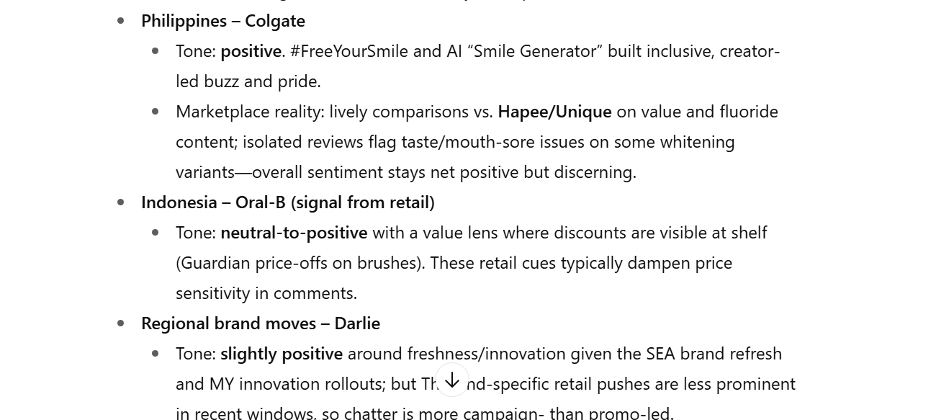
    (Screenshot from Pulse GPT indicating sentiments on brands in the oral care segment) 

    2. Turn Sentiment into Strategy 

    Sentiment isn’t a vanity metric. It’s your creative compass. 

    When your audience expresses dissatisfaction, that emotion often points directly to an opportunity.  

    Ask yourself and discuss with your team:

    • What emotions dominate your category right now? 
    • Are consumers showing excitement, fatigue, or frustration? 
    • Which emotional triggers could shape your next product or campaign idea? 

    When you understand how people feel and why, you can turn sentiment into strategy. 

    3. Watch Competitors the Way You Watch Consumers 

    Social intelligence isn’t just about listening to your own audience. It’s about understanding your entire category. 

    Use it to see what works for others before the reports arrive. In the FMCG space, these small insights often determine who wins shelf space. Pulse helps you track retailer programs, brand promotions, and competitor activity across hundreds of chains, so you can make informed moves ahead of the market. 

    Pro tips: 
     

    • Create a monthly “chatter map.” 
    • Review what consumers are saying about competing products and promotions. 
    • Ask: What unmet needs are driving those conversations? 

    4. Make Social Data Everyone’s Business 

    Social listening shouldn’t stay with the marketing team only. 

    Sales can use chatter about pricing or stock-outs to strengthen retailer negotiations. 
    Product teams can identify feedback such as “too much plastic” or “hard to reseal.” 
    Leadership can review category sentiment to guide strategy discussions. 

    When everyone in your organization has access to the same real-time consumer insights, your brand becomes faster, smarter, and more aligned. 

    That is the power of connected intelligence, which Pulse enables by bringing together sentiment, promotion, and trend data in one place. 

    5. Predict, Don’t Just React 

    The best FMCG brands don’t simply monitor conversations. They anticipate opportunities.  

    Emerging topics such as “gut health snacks” or “plastic-free packaging” often begin in niche online communities. By the time they appear in traditional reports, early movers have already captured the market. 

    You can use Pulse to spot these signals early.  

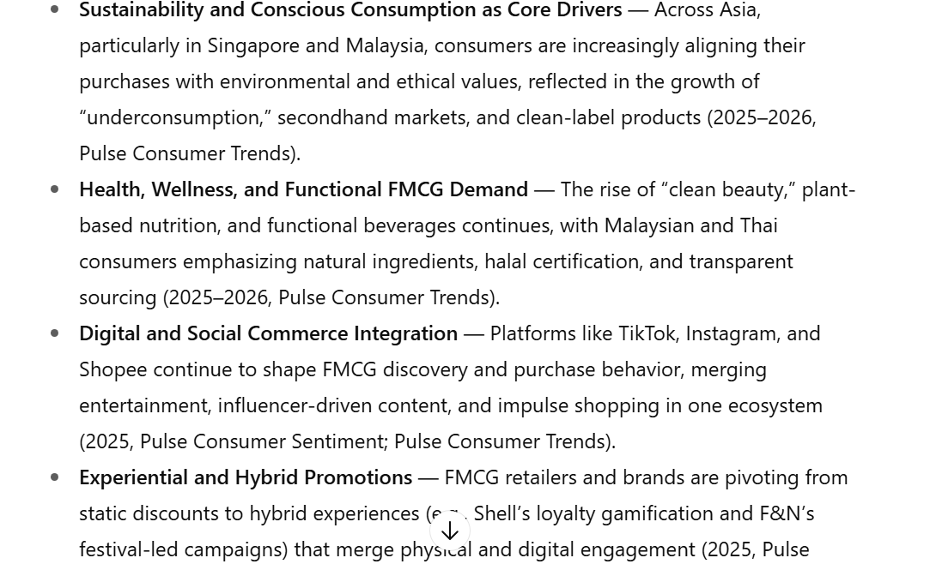
    (Screenshot from Pulse GPT on emerging FMCG trends)  

    Tips: 

    • Treat social chatter as your early warning system. 
    • Use it to identify micro-trends, validate ideas, and guide innovation. 
    • Combine structured data from Pulse to add context and credibility. 

    6. Build a Culture That Listens 

    The real differentiator isn’t the data. It’s your mindset. 

    Winning brands don’t wait for quarterly reports. They listen continuously, learn collectively, and act decisively. 

    Listening is no longer just a marketing skill. It’s a leadership discipline. 

    Because in FMCG, your next big opportunity probably won’t come from a brainstorming session. 
     

    It will come from a conversation happening online right now. 

    The Bottom Line 

    Social media isn’t noise. It’s your most dynamic source of consumer intelligence, a living narrative of what people value, celebrate, and critique. 

    When you can interpret that narrative and connect emotion to execution, you move faster and grow stronger. 

    Whether through your own analytics or through Pulse, which transforms billions of digital signals into actionable insight, one truth stands out: 
     

    The brands that listen best are the ones that lead next.