

Promotions have always been at the heart of FMCG marketing. From supermarket shelves lined with “Buy One Get One Free” offers to limited-edition packaging and influencer-driven giveaways, every promotion aims to capture attention and influence choice.
But behind every offer lies a complex mix of psychology, timing, and data. Promotions are no longer just an art of persuasion; they have become a science of prediction. In a world where consumer behavior shifts daily, understanding the data behind each purchase has become essential for marketers, sales leaders, and product innovators alike.
Understanding the Psychology Behind Every Purchase
Every promotion taps into deep-rooted human instincts. Scarcity creates urgency. Reciprocity builds loyalty. Social proof encourages trust and imitation. These behavioral principles are the foundations of why promotions work.
In the FMCG world, where decisions are often quick and habitual, these cues shape much of what ends up in a shopper’s basket. Yet not all promotions succeed equally. A “Buy One Get One” offer that boosts sales in Singapore may underperform in Malaysia. A viral contest on social media could outperform a traditional price cut.
The difference often lies in timing, context, and the surrounding competitive landscape. This is where data reveals what psychology alone cannot — the why and how behind each behavioral shift.
From Intuition to Data-Driven Precision
For years, FMCG teams have relied on post-campaign reports and gut instinct to guide their next move. But today’s world generates a constant stream of data from stores, retailers, and consumers. Every campaign leaves behind a digital footprint.
Intelligence platforms such as Pulse by GrowthDesk bring this data together into one view. They track what brands and retailers are promoting, how consumers are responding, and which messages are gaining momentum across social channels.
This level of visibility replaces intuition with precision. Instead of asking “What worked?”, marketers can now ask “What will work next?” By analyzing billions of data points from promotions, retailer programs, and consumer sentiment, brands can uncover patterns that drive measurable results.
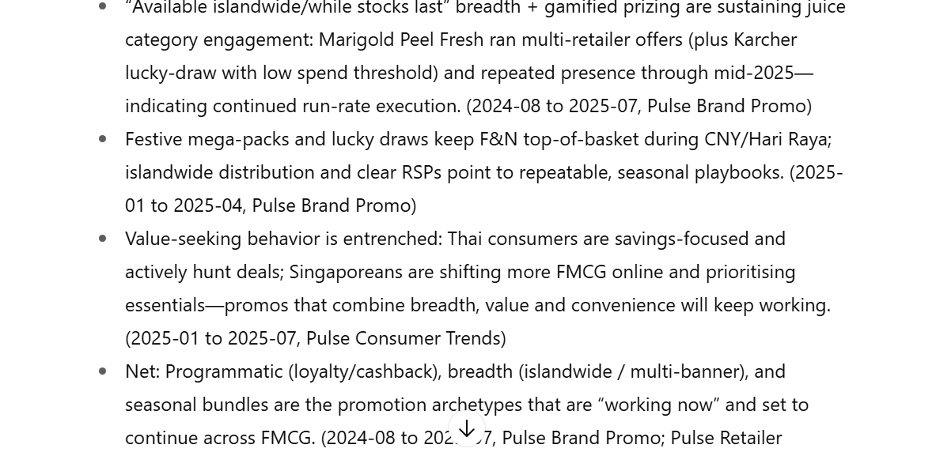
(Pulse Screenshot showing FMCG effective promotions in the region)
For instance, data may reveal that bundled offers perform best during festive months, while in-store contests drive higher engagement during new product launches. These insights turn promotions from experiments into repeatable success formulas.
Data as a Unifying Language Across Teams
The value of promotional intelligence goes beyond marketing.
Sales teams use it to align proposals with retailer calendars, ensuring their activations complement rather than compete with store campaigns.
Product and R&D teams monitor consumer sentiment to uncover unmet needs and innovation gaps, identifying emerging themes such as “better-for-you” snacks or eco-friendly packaging.
Executives and strategists use data to track brand health, benchmark against competitors, and spot category shifts early.
In this way, data becomes a shared language across functions, helping everyone make decisions grounded in evidence, not assumption.
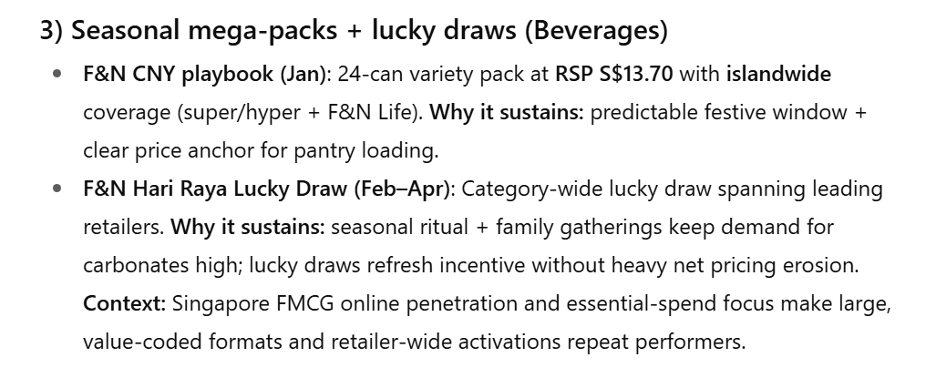
(Pulse data screenshot gives context and analysis on trends in the different FMCG promotions running)
This closed feedback loop, where each campaign generates insights that refine the next, is the essence of the new promotion science. It transforms short-term campaigns into long-term learning systems that build brand equity and market share over time.
From Transactions to Trends
Every promotion tells a story about changing consumer behavior. When viewed in isolation, it may look like a single sales tactic. When analyzed at scale, it becomes part of a bigger trend.
A rise in price-based promotions could signal economic caution among consumers. An increase in digital engagement around health-related products could point to a growing wellness mindset.
Understanding these signals helps brands anticipate shifts rather than react to them. The ability to see beyond sales numbers into sentiment, frequency, and message resonance enables marketers to stay one step ahead.
This is the real transformation happening across FMCG, from transactional thinking to trend intelligence.
The Next Frontier: Predictive and AI-Driven Promotions
The future of FMCG promotions lies in prediction. With AI copilots trained on verified FMCG data, teams can test scenarios before going to market.
What if you increased discount depth in hypermarkets? What if you ran an in-store contest instead of a digital raffle?
These questions can now be simulated and answered with confidence.
Platforms like Pulse make this possible by integrating directly with a brand’s systems through dashboards, APIs, or Snowflake environments. This enables organizations to ground their AI assistants in real, validated data rather than surface-level trends.
The result is a new kind of intelligence: AI that not only predicts outcomes but explains the behavior behind them.
When Creativity Meets Evidence
Promotions will always rely on creativity and storytelling. But creativity today needs the clarity that only data can provide.
The most successful FMCG companies are blending the art of marketing with the science of intelligence. They are using data not just to react faster, but to think smarter, to anticipate what consumers want and meet them there first.
The science of promotions is no longer abstract. It is practical, measurable, and accessible to every team that chooses to look deeper into the data.
And for those who do, platforms like Pulse serve as a compass, helping brands navigate consumer behavior with confidence, precision, and purpose.